

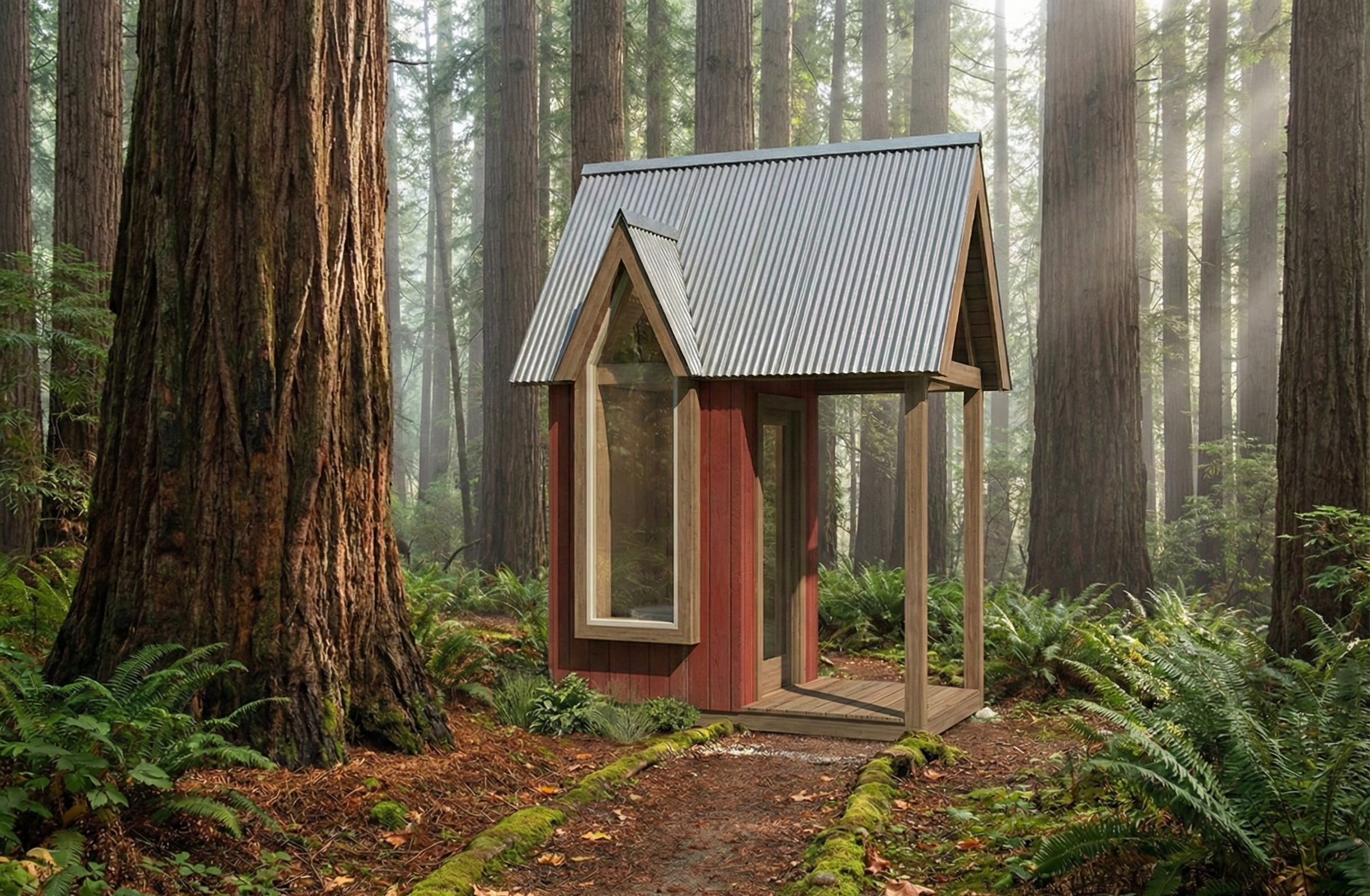
One of the things that originally drew me to tiny hose design was the puzzle of it—the challenge of packing maximum utility into the smallest possible footprint. I once challenged myself to design a house just 9 square feet to test the practical lower limits of human habitation. This was back in 2008.
I called it “Nine Tiny Feet.” I never built it, wish I had. The floor space was 3’x3′ and it included a kitchen, desk, seating, toilet, and shower. The sleeping loft, (not included in the square footage due to ceiling height), extended over the porch. My design is pictured on the left and faithfully rendered by Gemini. The plans for this no longer exist, I can’t find them anywhere. If there is interest, I will redraw them from memory.
Even if you never intend to live in a micro home, there is measurable value in studying how they work. Designs like these demonstrate extreme space optimization and multimodal living—concepts that apply to homes of any size.
Perhaps most importantly, I designed the house plans for regular people to build. Unlike standard architectural blueprints, which can be cryptic to the untrained eye, these are presented more like assembly instructions. My goal was to demystifying the construction process—walking through how a complex roof is framed, how a dormer is attached, and how a bay window comes together step by step.
It’s early February 2026, and I’ve returned to the archive for this final look.